The captivating tale of Nail History spans ancient civilizations, royal palaces, influential empires, and contemporary beauty salons. Throughout the ages of nail care, nails have symbolized much more than just beauty. They have represented affluence, authority, aristocracy, cleanliness, innovation, and social standing.
Have you ever thought about the reasons individuals polish their nails? What is the purpose of manicures, and how did nail grooming become a significant aspect of beauty standards globally?
A lot of individuals believe that nail care is a contemporary fad shaped by fashion publicationsand social networks. Did you realize that for over 5,000 years, humans have been adorning, styling, and maintaining their nails?
From the henna-colored nails of Ancient Egypt to today’s advanced gel manicures, nail care has consistently progressed while still serving as a significant means of self-expression.
In this comprehensive guide, we will delve into the entire timeline of nail care, investigate how ancient cultures influenced beauty practices, follow the development of manicure history, reveal the intriguing History of Nail Polish, and analyze how contemporary nail culture developed.
What is the history of nails and why does it matter?
Why would anyone be interested in the history of nails?
Nails are more than a beauty symbol — they represent centuries of culture, influence, and individual expression. From henna-marked fingers in ancient Egypt to the current viral nail art phenomena, nails have consistently conveyed a significance beyond what is apparent. In this article, we explore the extensive history of nail care, some astonishing world records, and how nail culture has transformed into the artistic industry we appreciate today.
Examining the history of nails uncovers two intriguing, entirely different topics:
the history of fastening hardware and the history of nail grooming and care. Investigating these topics reveals fascinating elements of human culture:
The Evolution of Construction Fasteners (Nails as Hardware) The true unsung champion: The shift from hand-forged wrought iron nails to mass-manufactured wire nails transformed architectural practices worldwide. Prior to the advent of inexpensive nails, large timber-framed constructions required intricate wooden joinery.
Historical dating: The evolution of nail production techniques—from hand-forged (pre-1800) to cut (early 19th-century) to wire (late 19th-century onwards)—provides archaeologists and historians with a clear timeline for accurately dating historical homes, ships, and structures.
Historical artifacts: The military importance of nails is documented in history; for instance, the Roman army abandoned seven tons of iron nails at the Inch Tuthill fortress in Scotland during their evacuation in 86 AD.
The History of Beauty (Nail Care and Art) Ancient emblems of status: Nail maintenance has lasted for millennia. In ancient Egypt and China, the hue and length of one’s nails signified their social status and if they were free from physical work.
Battle aesthetics: Although beauty was frequently the main concern, Babylonian warriors applied kohl to their nails to instill fear in foes prior to combat.
The origins of contemporary acrylics: The development of modern acrylic nails occurred unexpectedly when a dentist in the 1950s utilized dental products to repair a damaged fingernail. Whether your interests lie in structural engineering, industrial manufacturing, or the progression of beauty and culture, the simple nail reflects human creativity.
At a first look, nails might appear as a minor aspect of one’s appearance. Throughout history, nails have mirrored cultural values, social status, fashion styles, and individual identity.
The tale of Nail History shows us how beauty standards changed throughout history and how individuals communicated their status and power via their appearance.
The reality that many modern nail care practices date back thousands of years is perhaps the most unexpected.
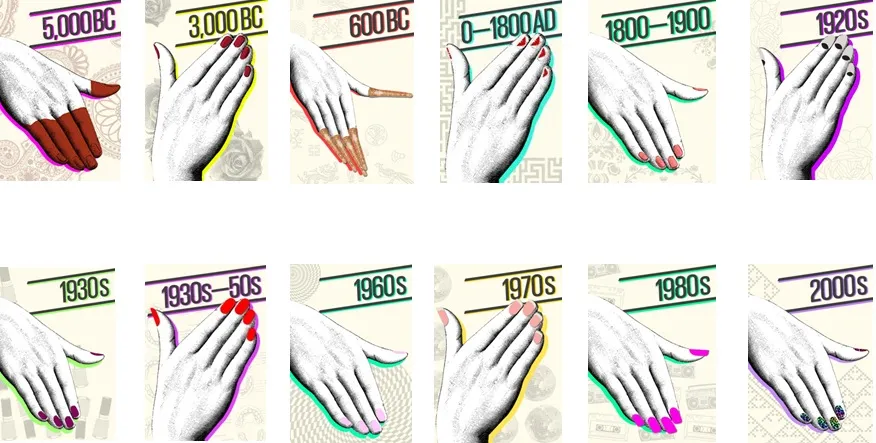
Nail History Timeline: A Journey Through the Ages:
Before diving into specific civilizations, let’s look at the major milestones in the History of nail care through centuries.
- 5000 BCE: Ancient Egyptians begin coloring nails with henna.
- 3200 BCE: Babylonians create gold manicure tools and color their nails before battle.
- 3000 BCE: Chinese royalty develops early nail lacquers made from natural ingredients.
- 2500 BCE: Nail color becomes a symbol of status in Egypt.
- 1st Century CE: Greeks and Romans emphasize grooming and nail hygiene.
- Middle Ages: Nail care continues primarily as a hygiene practice.
- Renaissance Era: Beauty and grooming regain popularity among European elites.
- 1800s: The modern manicure begins emerging in Europe.
- 1920s: Modern nail polish is introduced.
- 1950s–1960s: At-home manicure kits become widely available.
- 1970s–1990s: Acrylic nails and professional nail salons gain popularity.
- 2000s–Present: Gel manicures, nail art, and social media revolutionize nail culture.
This timeline demonstrates how dramatically nail care has evolved throughout human history.
Ancient Nails: The birth of Nail Care:
When did people start paying attention to their nails?
The response leads us thousands of years into the past to the oldest civilizations. Ancient cultures perceived nails in a manner quite distinct from contemporary buyers. Nails were not merely ornamental. They frequently symbolized social status, power, and entitlement.
The history of ancient nails shows a strong link between beauty and social status. Let us examine the cultures that established the basis for contemporary nail care.
Nails in Ancient Egypt: The First Beauty Fashion:
What makes Ancient Egyptian Nails regarded as a crucial part of Nail History?
Ancient Egypt elevated nail care to an elegant beauty practice. Historical records indicate that Egyptians were among the earliest individuals to apply natural dyes for nail coloring.
Did Egyptians Use Nail Polish to Indicate Social Status?
Certainly.
Nail polish served as an evident indicator of social status. The deeper the hue, the greater the status. Royal family members commonly donned rich reds, whereas softer hues were designated for lower social classes.
This turned nails into a significant social emblem.
Which Egyptian queens impacted nail fashion?
Two iconic queens are frequently linked to nail elegance.
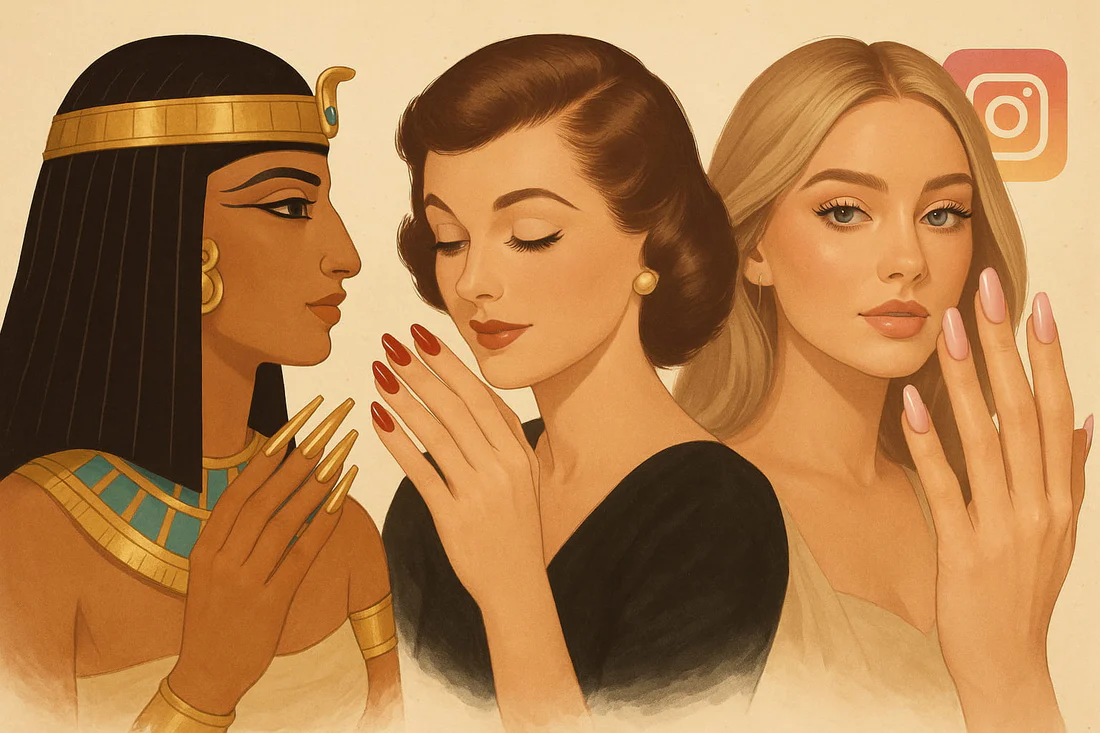
First one was Cleopatra said to have favored luxurious reddish-brown nail shades made with henna.
Second one was Nefertiti was famous for intricate beauty routines that involved decorating nails.
Their impact contributed to Egypt becoming one of the first hubs of nail beauty culture.
Which Products Were Utilized by Egyptians?
Ancient Egyptians depended on:
- Henna
- Organic dyes
- Dyes from plants
- Aromatic oils
- Plant extracts
Numerous contemporary natural nail treatments continue to utilize comparable ingredients today.
Ancient China and the Emergence of Opulent Nail Treatments:
In what ways did China impact the history of nails?
Approximately 3000 BCE, the royal class in China created some of the earliest nail polishes in history.
These initial formulas were surprisingly advanced. Ingredients included:
- Beeswax
- Egg whites
- Gum Arabic
- Gelatin
- Flower pigments
These mixtures produced decorative nail colors that became symbols of prestige.
Were Certain Nail Colors Reserved for Royalty?
Affirmative.
During different Chinese dynasties, the color of nails indicated social status.
Gold, silver, and crimson hues were frequently limited to aristocratic families.
Long nails became symbols of status as they indicated liberation from manual work.
What Were Nail Shields?
Decorative nail guards made of gold and silver were commonly worn by Chinese aristocrats.
These safeguarding ornaments protected lengthy nails while showcasing affluence and position. This tradition stands as one of the initial instances of upscale nail artistry.
Babylonian Nails: Merging Aesthetics and Combat
Is there a link between nail care and military strength?
Unexpectedly, indeed. Ancient Babylon presents one of the most captivating sections in the history of manicure. Archaeologists found manicure sets crafted entirely from gold that are thousands of years old.
Why did Babylonian fighters color their nails?
Historical records indicate that Babylonian warriors painted their nails prior to combat.
Various shades indicated military rank. Higher-ranking warriors typically wore dark colors. This custom illustrates how ancient nails had practical social roles in addition to aesthetics.
Nails conveyed power, dominance, and status.
Greece and Rome: The Emergence of Grooming Culture:
In what ways did the Greeks and Romans impact nail care?
In contrast to Egypt and China, Greece and Rome emphasized cleanliness over vibrant nail colors. Personal grooming turned into a symbol of sophistication and culture.
How Were Their Nails Maintained?
Historical documents indicate they utilized:
- Oils
- Fats from animals
- Polishing substances
- Shine cloths
Instead of vibrant nails, their aim was to achieve healthy, glossy nails. Numerous contemporary nail buffing methods can be linked back to these traditions.
Nail Care in the Medieval and Renaissance Periods:
What occurred following the decline of ancient civilizations? Has nail care vanished?
Absolutely not.
Nail Maintenance in the Middle Ages:
In medieval Europe, opulence was frequently disapproved. Nonetheless, personal cleanliness continued to be significant. Individuals kept their nails tidy, although intricate nail art became less frequent.
Nails displayed hygiene instead of social standing.
The Renaissance Reawakening:
In the Renaissance, beauty regained its popularity. Creative expression, style, and individual appearance thrived. European elites buffed their nails with powders and fabrics to achieve a glossy finish.
This time facilitated the reconnection of age-old beauty customs with new contemporary methods.
Manicure History: The Emergence of Contemporary Nail Care:
When did contemporary manicures start?
The majority of beauty historians attribute this to 19th-century Europe. This era signifies a significant shift in the history of manicures.
What has been altered?
For the first time, specialized tools for nails were readily accessible. Beauty experts created methods for:
- Shaping nails
- Nail fold maintenance
- Polishing
- Nail care
Orange wood sticks gained popularity for cuticle treatment. Manicures transformed from basic maintenance into organized beauty procedures.
Chronicles of Nail Polish: From Historical Tints to Contemporary Hues:
A particularly intriguing aspect of Nail History is the evolution of nail polish. How did humans evolve from henna to a multitude of polish shades?
Historical Nail Shades:
Ancient cultures depended on:
- Mehndi
- Pigments in flowers
- Botanical pigments
- Powdered minerals
These components produced a brief nail hue.
The Victorian Period:
During the Victorian era, women applied tinted creams and polishing powders to achieve shine.
Buffing turned into a regular nail care routine. Achieving shiny nails, however, demanded considerable effort.
The Birth of Nail Lacquer:
All aspects transformed in the early 1900s.
Car makers created glossy paint coatings. Beauty innovators modified comparable technology for cosmetic applications.
The Revolution of the 1920s:
Contemporary nail polish emerged in the 1920s.
Women were able to achieve smooth, shiny, and enduring color for the first time. The beauty trade rapidly included the trend.
Hollywood and the Golden Age of Nails:
In what ways did film celebrities shape nail fashion?
Hollywood significantly contributed to the widespread popularity of manicures. During the 1920s, 1930s, and 1940s, female stars displayed elegant nails in films. Women globally imitated their beloved celebrities. Out of the blue, well-groomed nails transformed into a beauty necessity instead of an extravagance.
This era hastened the development of contemporary nail culture.
The Development of Nail Care: 1950s to 1990s:
What occurred once nail polish gained popularity?
Innovation sped up quickly.
The 1950s and 1960s:
Soft nail hues gained popularity. Home manicure kits became increasingly popular. Nail care became available to women across all income brackets.
The 1970s and 1980s;
Vibrant hues ruled the fashion scene. Vibrant colors, sparkle, and artistic nail art gained popularity.
Acrylic Nail Transformation:
Artificial acrylic nails became a significant trend in beauty. They provided resilience, toughness, and extension.
Nail Art in Japan:
In the 1990s, nail artists from Japan created intricately detailed nail designs.
Their creative advancements influenced the development of contemporary nail art culture.
Pedicure History: The Overlooked Partner to Manicures
Did pedicures develop concurrently with manicures?
Affirmative.
The term “pedicure” derives from Latin words that signify “care for the feet.”
Historical records indicate that individuals have maintained their toenails for over 4,000 years. The ancient Babylonians utilized gold tools for grooming, to perform both manicures and pedicures. Currently, manicures and pedicures are still tightly linked beauty services.
Nail Maintenance in Modern Era
In what ways has nail care evolved in today’s society?
Consumers today possess more options than they ever did previously. Contemporary nail treatments encompass:
- Gel nail treatments
- Acrylic nails
- Powder-dipped nails
- Art on nails
- Gemstones for nails
- Nail designs in 3D
Nail salons that offer professional services can now be found across the globe. What was previously meant for nobility is now available to almost everyone.
How Social Media Transformed Nail Art History:
Could nail influencers have existed in ancient societies?
Most likely not.
Nail culture was revolutionized by websites like YouTube, Instagram, Pinterest, and Tik Tok. Nail artists may now quickly share their work with millions of people.
Popular Modern Trends:
- Minimalist nails
- Seasonal designs
- Chrome finishes
- Gel extensions
- 3D embellishments
- Celebrity-inspired manicures
Social media has converted one of the most controlling forces in current Nail History.
What are the latest advancements in nail care?
- Gel Manicures: Gel formulas provide enduring gloss and strength. Numerous users appreciate chip-resistant outcomes that endure for several weeks.
- Nail Stickers: Nail stickers offer a fast option to conventional nail polish.
- Gel Nail Stickers: Contemporary gel nail stickers merge ease of use with long-lasting strength.
They are intended to:
- Safeguard natural nails
- Minimize chemical contact
- Provide simple application
- Endure for multiple weeks
These advancements keep broadening the options for nail aesthetics.
What Lessons Can We Take from Ancient Nails Now?
Do age-old nail customs still hold significance?
Certainly.
Numerous teachings from ancient cultures continue to be applicable.
- Botanical Remedies: Traditional societies depended on natural therapies. Currently, shoppers are more inclined to look for natural nail care items.
- Nail Protection: Ancient aristocrats took great care in safeguarding their nails. Contemporary nail health also relies on avoiding harm.
- Personal Expression: Nails have symbolized identity and creativity throughout history. This practice stays the same.
The tale of ancient nails still motivates contemporary beauty trends.
The Coming Era of Nail History:
Where is nail care going next?
Newly developed innovations encompass:
- Eco-friendly nail products
- Sustainable packaging
- Safe, non-harmful compositions
- Intelligent beauty technology
- Customized nail care services
As beauty trends change, nails will keep being strong means of self-expression. The upcoming chapter of Nail History is currently in the process of being penned.
Among the first documented populations to use natural pigments and dyes to color their nails were the Chinese nobility and the ancient Egyptians.
Nail color used as a social status indicator in ancient Egypt. Generally speaking, darker hues were connected to nobility and monarchy.
The first known manicure tools were found in Babylonia and are thought to have been made around 3200 BCE.
In the 1920s, cosmetic industries borrowed technology from car paint to create modern nail polish.
While current nail care includes sophisticated tools, artificial improvements, and expert salon services, ancient nails relied on natural dyes, oils, and manual grooming.
Knowing the history of nails enables us to recognize how beauty customs have changed throughout time and how nail care still reflects individuality, creativity, and culture.
Conclusion:
Nail History is a fascinating tale that takes place across thousands of years. Nails have always been more than just a cosmetic item, according to the centuries-long history of nail care. Power, social standing, inventiveness, individuality, and cultural values have all been represented by them.
Every age has contributed to the development of nail care, from Babylonian warriors to contemporary nail influencers, from the henna-stained Egyptian nails of Cleopatra and Nefertiti to the opulent nail guards of Chinese dynasty.
One thing is evident whether researching the history of manicures, analyzing ancient nails, or tracking the development of nail polish: people have always been fascinated with gorgeous nails.
The future of nail care is expected to be equally as exciting as its history due to the emergence of new technologies and trends.